

Track Introduction
This track is jointly customized by Tencent AI Arena Platform and Enflame Technology, focusing on operator development as the key assessment point, connecting to the real-world scenario of domestic chip development, and examining students' learning and practical abilities in operator framework development in the field of artificial intelligence and deep learning.
Target Participants
This track is jointly customized by Tencent AI Arena Platform and Enflame Technology, focusing on operator development as the key assessment point, connecting to the real-world scenario of domestic chip development, and examining students' learning and practical abilities in operator framework development in the field of artificial intelligence and deep learning.
Rewards
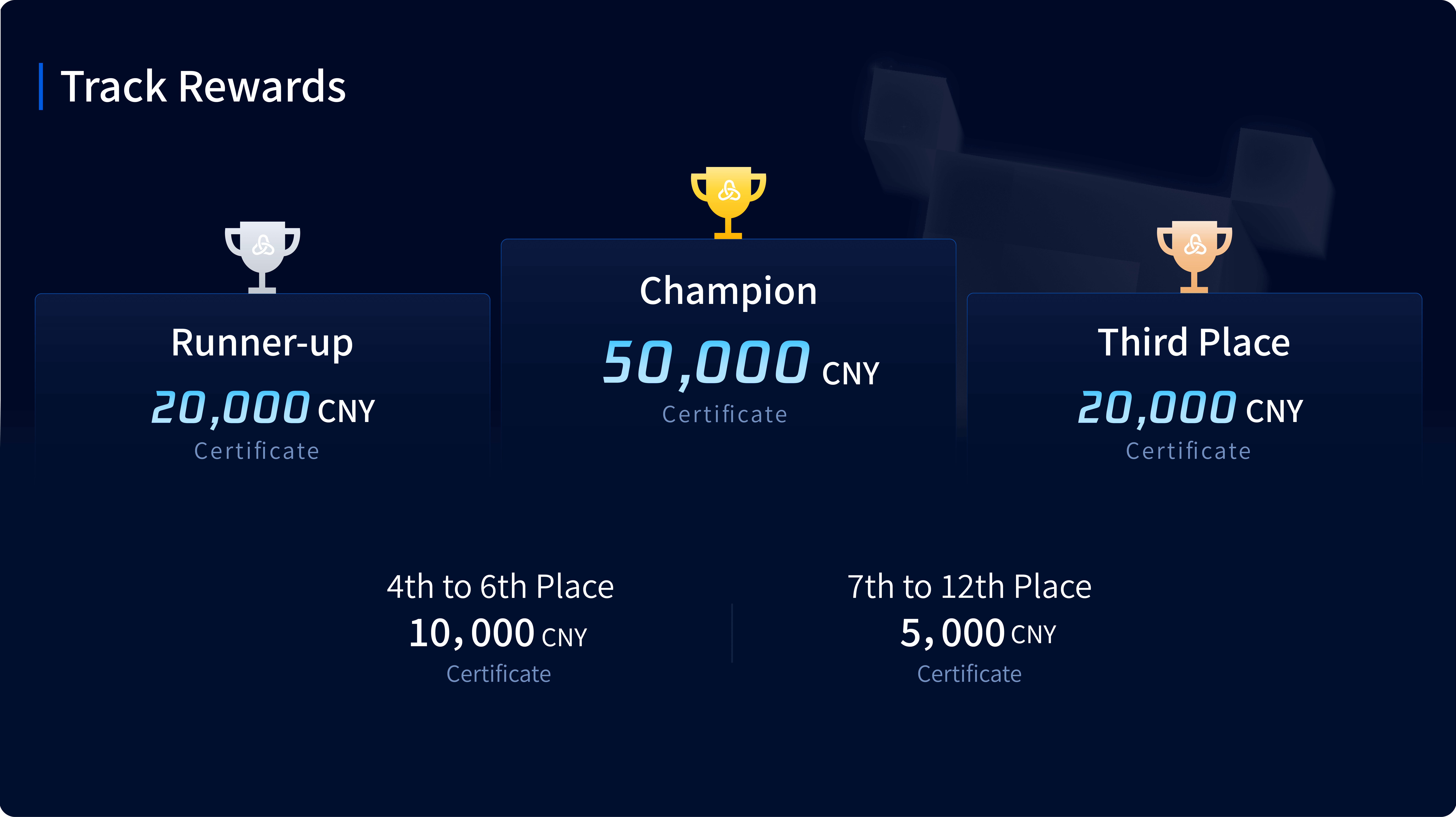
The prize money for this track is set as above, with amounts in Chinese Yuan (CNY) and pre-tax.
In addition to the prize money, participating teams will also receive the following rewards:
All teams completing the competition (by successfully submitting a model and passing verification) will be awarded an official certificate of participation.
Exceptional participants may have the opportunity to secure internships related to Tencent's AI Arena Program and gain priority access to Tencent Group's campus recruitment and internship programs. Detailed information will be provided later.
Schedule
About the Challenge: Based on the specified version of the GCU Operator Development Suite, participants are required to complete specified operator development tasks using the TopsRider Kernel Runtime. Operators are core computational tasks required for AI model calculations. Each task includes several sets of acceptance test cases, covering both functional accuracy and performance cases. Specific operator tasks can be found in the competition guidelines.
Objective: This challenge tests participants' ability to learn and develop using the GCU Development Suite. Through the competition, participants will master the development paradigms of core operators that AI models depend on.
Ranking and Advancement Rules: In the preliminary round, participants must complete specified operator development tasks on the competition platform and submit their code as required. The competition platform will calculate scores and rankings based on the test results of the submitted code. The top 30% of teams based on the final valid scores from the preliminary round will qualify for the next stage. After verification, these teams will advance to the finals. If fewer than 30 teams qualify, teams will be selected based on their rankings, from highest to lowest, unless there are special circumstances.
About the Challenge:Based on the specified version of the GCU Operator Development Suite, participants are required to complete operator development tasks, submit a technical report, create a PowerPoint presentation, and deliver a technical proposal presentation followed by a technical defense.
Objective:This phase assesses participants' practical ability to learn and use the GCU Operator Development Suite, their ability to understand and analyze the competition topic, their solution design and optimization capabilities, and their ability to present and defend their technical proposals.
Ranking:In the finals, participants must complete the specified operator development tasks through the competition platform and submit their code as required. The competition platform will calculate scores and rankings based on the test results of the submitted code. The top 12 teams will advance to the offline defense session.